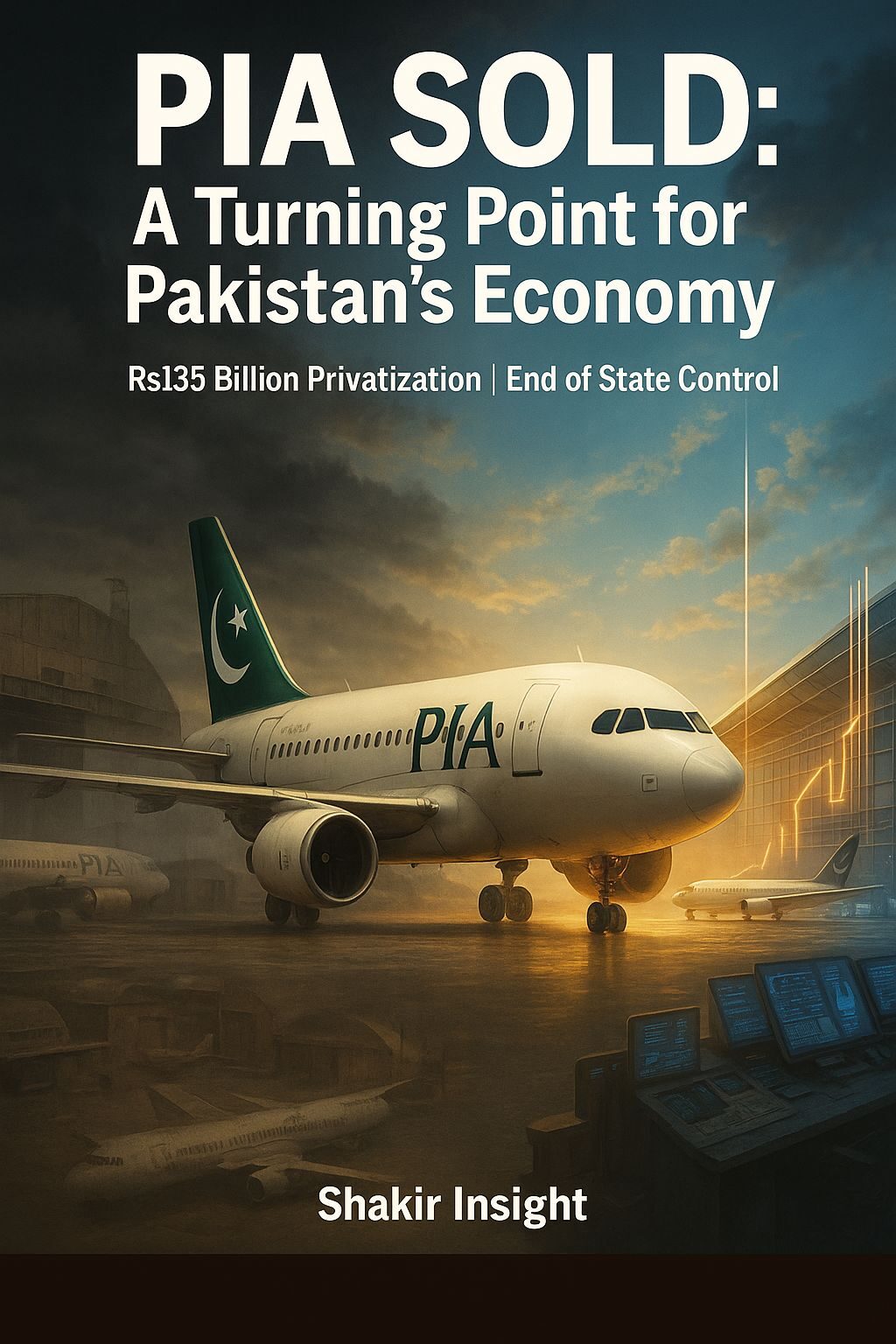
Pakistan International Airlines (PIA) has officially been sold, with 75% ownership transferred to a private consortium for Rs135 billion. This marks the end of government control over PIA’s daily operations after decades of financial losses. The move aims to stop taxpayer-funded bailouts, improve efficiency, and revive the national airline. It is Pakistan’s most significant privatization deal in nearly 20 years.
PIA Privatization in Pakistan: What Really Happened and Why It Matters

Introduction

The privatization of Pakistan International Airlines (PIA) has become one of the most talked-about economic events in Pakistan’s recent history. After years of mounting losses, political interference, and failed reform attempts, the government has finally transferred majority ownership of the national airline to the private sector.
This decision is not just about selling an airline—it represents a major test of Pakistan’s economic reform agenda, investor confidence, and ability to fix failing state-owned enterprises.
What Is PIA Privatization?
PIA privatization refers to the transfer of majority ownership and management control of Pakistan International Airlines Corporation Limited (PIACL) from the Government of Pakistan to a private investor.
Key Facts:
- 75% of PIA shares sold
- Rs135 billion acquisition value
- Private consortium now controls management
- Government retains minority stake with exit option
The objective is clear:
👉 reduce losses, attract investment, and run PIA on commercial principles instead of political decisions.
Why Was PIA Sold?
PIA was once among Asia’s leading airlines, but over time it became a financial burden.
Major Reasons Behind the Sale:
- Annual losses of Rs50–100 billion
- Heavy debt and poor governance
- Political appointments and interference
- Inefficient operations and grounded fleet
- International flight bans damaging revenue
Continuing government ownership was no longer sustainable.
Benefits and Disadvantages of PIA Privatisation for the People of Pakistan
Privatisation affects more than just balance sheets—it directly impacts ordinary citizens, workers, and the national economy. Below is a clear, people-focused breakdown.
Benefits of PIA Privatisation for Pakistani Citizens
1. Reduced Burden on Taxpayers
For years, public money was used to cover PIA’s losses. Privatisation stops billions of rupees in taxpayer-funded bailouts, allowing funds to be redirected to healthcare, education, and infrastructure.
2. Better Air Travel Experience
Private management prioritizes:
- On-time flights
- Improved safety standards
- Better customer service
- Modern aircraft
Passengers benefit from reliability and comfort instead of chronic delays.
3. Economic Growth and Investment
A profitable PIA supports:
- Tourism growth
- Cargo and trade expansion
- Job creation across aviation and related sectors
This strengthens Pakistan’s overall economy.
4. Employment Growth Through Expansion
Unlike common fears, expansion plans mean:
- More aircraft
- New routes
- Higher demand for skilled pilots, engineers, and ground staff
Growth creates jobs rather than eliminating them.
5. Stronger International Image of Pakistan
A well-run national airline improves Pakistan’s reputation globally, increasing investor confidence and international connectivity.
Disadvantages and Risks of PIA Privatization for Pakistani Citizens
1. Risk of Higher Ticket Prices
Private operators aim for profit. On less competitive or remote routes, fares could increase if regulation is weak.
2. Job Insecurity Concerns
Although mass layoffs are not planned, efficiency-driven restructuring may:
- Change work conditions
- End overstaffing practices
- Increase performance pressure on employees
This creates anxiety among workers.
3. Loss of Government Control
Strategic decisions—such as routes, pricing, or national emergencies—will no longer be fully under government control.
4. Risk of Monopoly Power
If aviation regulation is weak, a dominant private PIA could limit competition, affecting fares and service quality.
5. Dependence on Strong Governance
Privatization will fail if:
- Political interference continues indirectly
- Investment commitments are not enforced
- Regulators remain weak
Ownership change without governance reform harms public interest.
Balanced Reality Check
PIA privatisation is neither purely good nor purely bad for the people of Pakistan.
Its success depends on:
- Independent regulation
- Transparent monitoring
- Protection of public and strategic interests
If governed wisely, the benefits will outweigh the risks.
How the PIA Privatization Deal Was Executed
The government followed a structured and transparent process to ensure credibility.
Step-by-Step Process:
- Balance Sheet Cleanup
Over Rs33 billion in liabilities were removed before sale. - Asset and Debt Segregation
Old debts shifted to a separate holding entity. - Regulatory Clearance
EU and UK flight bans were lifted. - Pre-Qualification of Investors
Financially capable bidders shortlisted. - Competitive Bidding & Open Auction
Sealed bids followed by a live auction. - Award of Majority Stake
Highest bidder secured 75% ownership.
This approach boosted investor confidence and ensured fair price discovery.
Who Bought PIA?
A private consortium led by Arif Habib Group acquired the majority stake.
Why This Matters:
- Strong financial backing
- Experience in large-scale investments
- Ability to inject capital quickly
- Commercial decision-making free from politics
What Changes After Privatization?
Privatization does not guarantee success—but it changes incentives.
Expected Improvements:
- Fleet expansion and new aircraft
- Better maintenance and safety standards
- Demand-based route planning
- Improved punctuality and service quality
- Digital systems and modern management
Impact on PIA Employees
A major concern was job security.
Reality:
- No immediate mass layoffs announced
- Expansion plans mean more pilots, engineers, and ground staff
- Focus on skill development rather than downsizing
Growth, not cuts, is the stated strategy.
Economic Impact on Pakistan
If managed correctly, PIA privatization can:
- Reduce burden on national budget
- Attract foreign and local investment
- Improve tourism and cargo trade
- Strengthen Pakistan’s aviation ecosystem
- Build confidence in future privatization efforts
Risks and Mistakes to Avoid
Privatisation can fail if governance collapses.
Key Risks:
- Political interference after sale
- Weak aviation regulation
- Failure to enforce investment commitments
- Ignoring employee morale
- Short-term profit focus over long-term growth
Ownership change alone is not reform—strong regulation is essential.
Expert Opinion
Economists agree that PIA’s sale is a necessary reset, not a miracle cure.
Success depends on:
- Independent aviation regulation
- Stable government policies
- Transparent monitoring of private owners
- Protection of strategic national interests
Conclusion
The sale of PIA for Rs135 billion marks a turning point in Pakistan’s economic history. For the first time in decades, a major state-owned enterprise has been privatized through a transparent and competitive process.
If capital is invested wisely and governance remains independent, PIA can once again become a respected regional airline instead of a taxpayer-funded liability.
This is not just about selling PIA.
It is about proving that Pakistan can reform, compete, and grow