Mars and Water: A Question That Refused to Fade
Mars is the one planet in our solar system that has kept humans asking the same question for decades: did water ever exist there, and if it did, could life have been possible as well? In the mid-twentieth century, early telescopic observations showed straight lines on the Martian surface. Many believed these were canals, but that interpretation was soon proven wrong. Still, the question of water did not disappear. With the dawn of the space age, a serious scientific effort began to search for concrete evidence of Mars’ watery past.

From Optical Illusions to Space Exploration
Once spacecraft replaced telescopes, the study of Mars entered a new era. Missions ranging from the Viking landers to modern orbiters were launched with one central goal: to understand whether Mars once supported liquid water. Each mission added small but important pieces to the puzzle, gradually moving the discussion from speculation to evidence-based science.

Ancient Rivers, Lakes, and a Wetter Mars
A major turning point came when scientists identified dried river channels, rocky deltas, and the shorelines of ancient lakes on the Martian surface. These landforms could not exist without flowing water. Their presence made one thing clear—Mars was once warmer and wetter than it is today. However, this discovery raised an even bigger question: if Mars once had so much water, where did it all go?

The Disappearing Water Problem
Scientists now believe Mars lost its water through multiple processes. Some of it escaped into space as the planet lost much of its atmosphere. Another portion froze and became trapped as ice at the polar caps. Yet a compelling possibility remained—that a significant amount of water did not disappear at all, but instead became locked beneath the surface.
A Mysterious Region Near the Martian Equator
Attention soon turned to a strange region near Mars’ equator known as the Medusae Fossae Formation. At first glance, it appeared to be nothing more than massive wind-shaped hills of dust. For years, scientists assumed it was composed of dry debris or volcanic ash. But newer observations began to suggest that something much more interesting was hidden below.
How Scientists Look Beneath the Surface of Mars
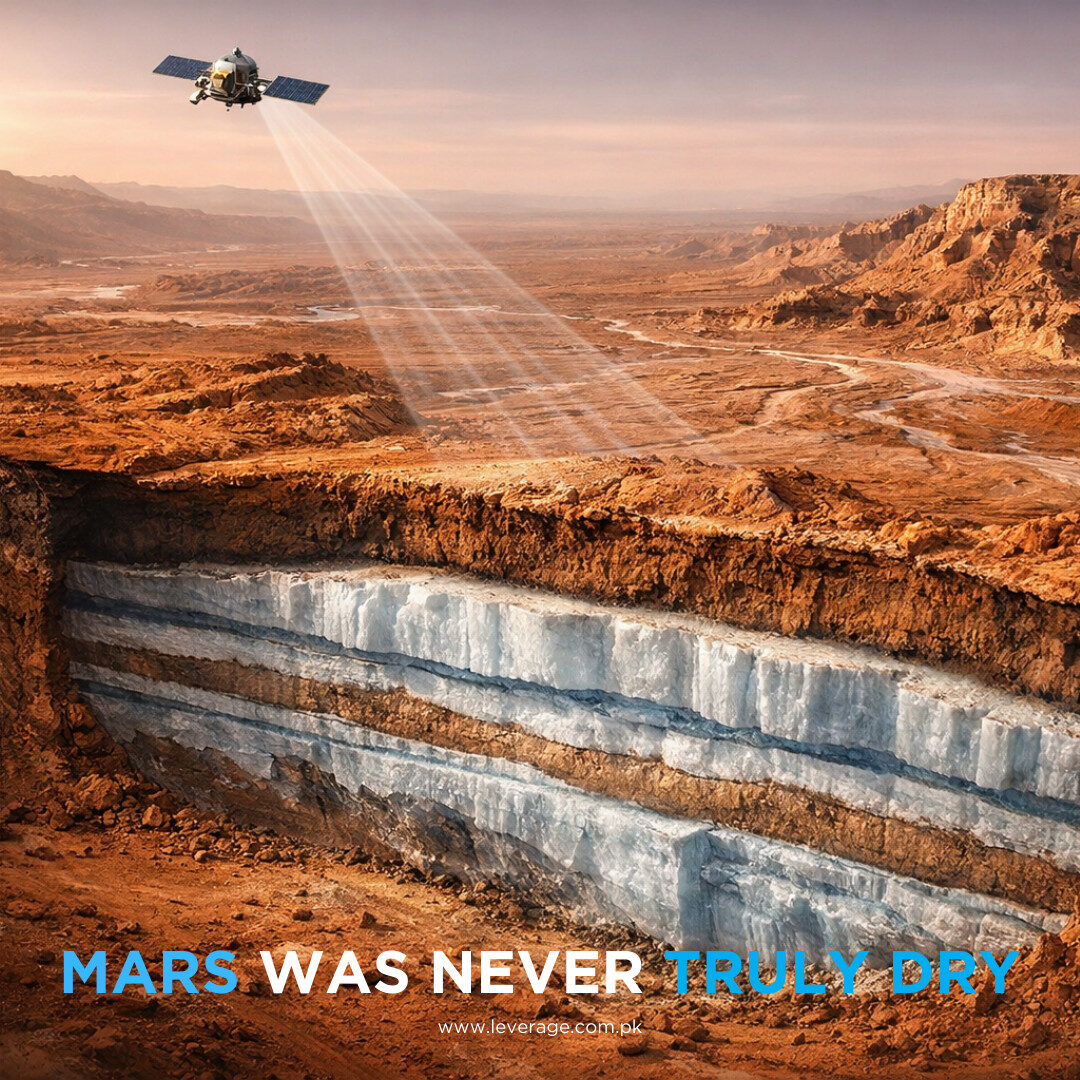
Direct drilling on Mars is extremely difficult, so scientists rely on indirect methods to study what lies underground. One of the most powerful tools is radar sounding. Orbiting spacecraft send low-frequency radio waves toward the surface. These waves penetrate deep into the ground and bounce back from different layers. By analyzing the strength and timing of these reflections, scientists can determine whether the subsurface material is rock, dust, or ice.
The Role of the Mars Express Radar
On Mars, this work is carried out by the MARSIS radar aboard the Mars Express orbiter. This instrument can probe several kilometers below the surface, offering an unprecedented look into Mars’ hidden layers. Its data has become crucial in understanding regions that appear dry on the surface but may conceal something very different underneath.

Thick Layers That Look Like Ice
Recent radar data revealed that the layers beneath the Medusae Fossae Formation are exceptionally thick—more than three kilometers in some places. Even more striking, their radar signatures closely resemble those of ice deposits found in Mars’ polar regions. Such thickness cannot be explained by dust alone, which would collapse under its own weight. Ice, however, can remain stable, especially when protected by a thick cover of dry material.

A Natural Shield Preserving Ancient Ice
Scientists now think this region contains multiple layers of dust and water ice, capped by a dry surface layer several hundred meters thick. This upper layer acts like a natural shield, protecting the ice below from sunlight and atmospheric loss. Finding such a massive ice reservoir near the equator strongly suggests that Mars’ climate in the past was very different from the cold, dry world we see today.
What This Says About Mars’ Ancient Climate
The presence of equatorial ice points to a time when Mars had a denser atmosphere and higher temperatures. Under those conditions, liquid water could remain stable on the surface for long periods. This supports the idea that early Mars may have been far more Earth-like than previously believed.
Why Water Matters in the Search for Life
Water has always been central to the search for life on Mars. On Earth, life exists wherever water is present, even in extreme environments. Subsurface water or ice is especially important because it is protected from harsh radiation at the surface. If microbial life ever existed on Mars, its traces are most likely preserved in such sheltered locations.
What This Discovery Does—and Does Not—Prove
It is important to be clear: this discovery does not mean liquid water has been directly observed on Mars. The conclusion is based on strong but indirect evidence. Radar data strongly points toward ice, but definitive confirmation will require future missions, possibly involving landers, advanced instruments, or deep drilling. This step-by-step approach is how science progresses.
A Milestone for Future Mars Missions
Despite these limitations, the discovery represents a major milestone in Mars research. It not only deepens our understanding of the planet’s past but also has practical implications for future human exploration. Water is a critical resource, and accessible ice near the equator could play a vital role in sustaining future missions.
Hidden Stories Beneath the Red Surface
The ice concealed beneath Mars’ red surface is a powerful reminder that planets often hide their most important stories below ground. As technology improves, these silent layers may continue to reveal clues—not just about Mars, but about how planets evolve and how common the conditions for life may be in the universe.
— Dr. Ahmad Naeem