🌌 A New Solar System Is Forming—And It Mirrors Our Own Origins
🪐 Inside PDS 70: A Cosmic Nursery Where New Worlds Are Taking Shape
🚀 Introduction

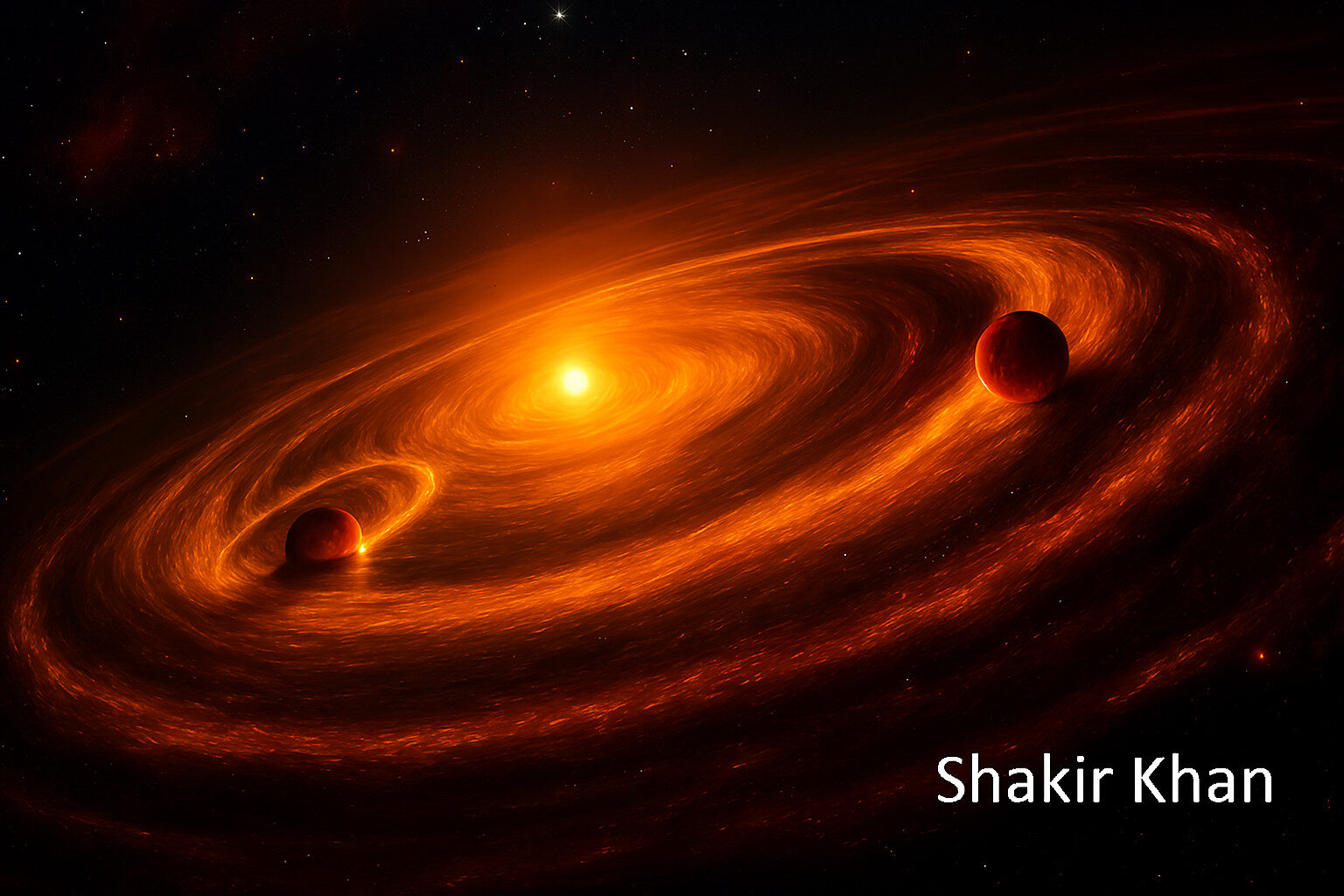
The journey to understand the universe reminds us that we’re not just observers—we’re part of a grand cosmic story. Right now, new worlds are forming before our eyes. A stunning image from the ALMA Observatory reveals a young solar system in its earliest stages of creation. This system, called PDS 70, lies about 400 light-years from Earth.
What We See
At the center of this system is a young star, surrounded by a wide ring of dust and gas. This ring, known as a circumstellar disc, is the raw material from which planets are born. These scenes reflect how our own solar system may have started.
The most surprising part? The same dust and gas that now float in space could one day become mountains, oceans—or even life. What looks like scattered particles today might become a planet like Earth tomorrow.
Planet Formation in Action

Inside this disc, two giant planets are forming. One of them, PDS 70 c, is especially interesting. It has its own smaller disc, called a circumplanetary disc. This isn’t just a side feature—it’s the foundation of a new world. It helps the planet grow and may even give birth to moons.
In other words, a mini solar system is forming around this planet—just like Earth and its moon.
These planets are reshaping the disc around them. As they move, they pull in dust and gas, carving paths through the disc. This process mirrors how our own solar system formed billions of years ago.
Echoes of Our Past
Scientists believe that Jupiter, Saturn, Uranus, and Neptune also carved paths through the disc during their formation. Today, their many moons still tell that story.
It feels like we’re looking into a time machine—watching our own past unfold in another part of the galaxy.
NASA’s View
NASA and the James Webb Space Telescope have provided detailed views of PDS 70. These observations help us understand how planets and moons form, and how systems like ours come to life.
Why It Matters
There may be billions of solar systems like PDS 70 in our galaxy. Each one could hold Earth-like planets, new moons, and stories waiting to be discovered. This isn’t just science—it’s a glimpse into the future of life beyond Earth.