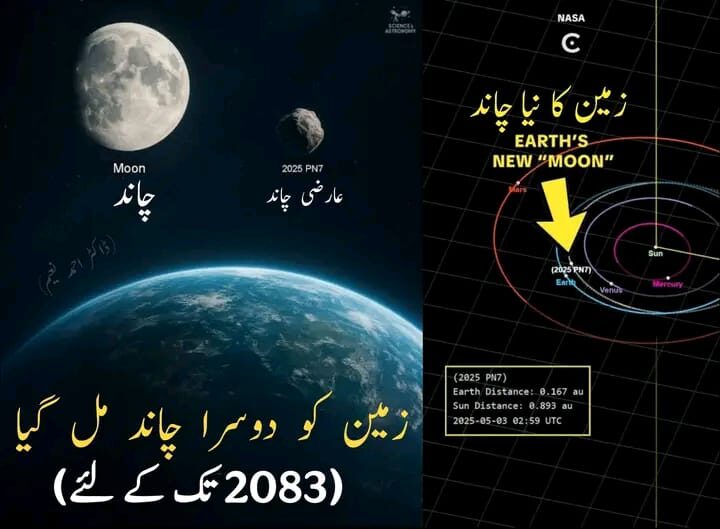
For centuries, the night sky has looked almost unchanged to us. Above our world, the Moon has always been our loyal companion—calm, bright, and familiar. But the universe has a habit of surprising us, and this time it has revealed a secret that has stunned astronomers worldwide:
Earth has gained a new companion — a second, temporary moon.

This newcomer isn’t huge, glowing, or permanent like our original Moon. It’s small, dim, and only passing by for a limited time. Scientists have named it 2025 PN7, and it will stay with Earth only until 2083. Objects like this are known as Temporarily Captured Objects (TCOs), quasi-moons, or more casually, mini-moons.
What Exactly Is a Mini-Moon?
Mini-moons are usually tiny rocks wandering freely through the solar system. When one of them passes close enough to Earth, our planet’s gravity sometimes grabs it, pulling it into a loose, unstable orbit. It then circles Earth for months—or even years—before eventually escaping back into space or burning up in our atmosphere.
These visitors don’t form perfect circular orbits like the real Moon. Their paths are twisted, chaotic, and unpredictable. But that’s exactly what makes them scientifically valuable.
We’ve Seen These Visitors Before
This isn’t the first time Earth has hosted a temporary moon. One of the most famous examples is 2006 RH120, which orbited Earth for nearly a year before drifting back into a solar orbit. Over the years, several tiny cosmic hitchhikers have spent time near Earth, but many of them were discovered late or observed only briefly.
The difference with 2025 PN7 is that it will be around for decades, giving scientists a rare chance to study it in detail.
Why Scientists Are Excited
This mini-moon offers a golden opportunity to study:
- How small space rocks move
- How Earth’s gravity captures and releases them
- The composition and behavior of small near-Earth objects
- Orbital mechanics that could guide future missions
Understanding these objects is important for future technologies—like asteroid mining, resource extraction, and even missions designed to deflect dangerous asteroids. The better we understand their motion, the better we can navigate and manipulate them.
Why We Can’t See It with the Naked Eye

Mini-moons are tiny compared to our real Moon. For example, a recent mini-moon discovered in 2024 was only about 10–11 meters across—smaller than a house. Something that small can’t reflect enough sunlight to be seen without powerful telescopes, and even then, only when it’s close to Earth.
Most of them are detected using radar or giant sky-survey telescopes designed to track near-Earth objects.
A Constantly Changing Sky
These temporary moons remind us of an important truth:
Space around Earth is not quiet or empty. It’s dynamic, active, and full of surprises.
The discovery of 2025 PN7 confirms that our solar system is more alive and complex than we once imagined—and that Earth is constantly interacting with its cosmic environment.
As this newly discovered mini-moon travels with us for the next half-century, scientists will be watching closely, learning more about the unseen guests that occasionally join Earth on its journey around the Sun.